 I’ve never bred any babies of my own (well, at least to the best of my knowledge). But have helped several friends in what must be one of the most taxing tasks ever known to mankind: that of finding appropriate names for babies.
While some of us want baby names to be unique, others are content with simply naming them after their favourite gods, goddesses, sport-stars, rock-stars, cine-stars…you name it! And yet others don’t give a damn…name and be done with it! After all, as the bard rightly philosophised: “Whats in a name? That which you call a rose, by any other name, would smell as sweet.”
A slightly dated report from the Global Post states that the Kiwis have begun regulating the branding of babies. I extract the relevant portions below:
“Celebrities with a penchant for weird baby names (looking at you, David and Victoria Beckham) should avoid having kids in New Zealand.
The country’s Registrar of Births, Deaths and Marriages has been cracking down on parents who get too creative when naming their kids, Australia’s Herald Sun reports.
The list of weird names for kids that are banned by New Zealand’s names registrar has grown to include Lucifer, Duke, Messiah and 89. Also not approved: Bishop, Baron, General, Judge, King, Knight and Mr., names that were all said to be too similar to titles.
The letters, C, D, I and T were also rejected as first names, the Herald Sun says.
As well, the agency has refused to allow names involving asterisks, commas, periods and other punctuation marks. And three different sets of Kiwi parents wanted to name their children Lucifer, only to have the name choice nixed.
In 2008, New Zealand’s names registrar drew international attention when it approved such non-traditional names as Benson and Hedges for a set of twins, as well as the boys names of Violence and Number 16 Bus Shelter.
But New Zealand isn’t the only country to ban wacky names for kids, the Toronto Globe and Mail reports. In Sweden, name choices are subject to a naming law. While Lego and Google have been approved as names for children, Superman, Metallica and Elvis… were not approved.”
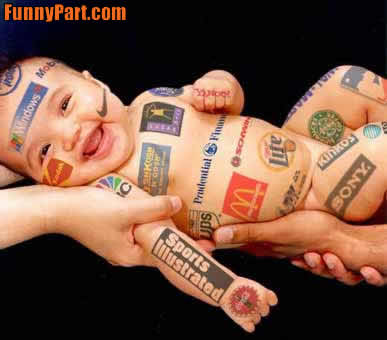
All of these instances got me thinking that perhaps, we are not far from the day when a Google or a Nokia lobbies hard for a law to prevent the naming of babies after their zealously guarded brands. After all, there is always the potential danger that when the baby is old enough to run a business, he/she legitimately claims the right to use his/her personal name (eg. Google Singh or Nokia Nair) as part of the business. Illustratively, most trademark lawyers are familiar with Armani’s failed attempt at securing the “armani.com” domain name registered by “A.R. Mani”, where the WIPO arbitrator held that Mr Mani had a very legitimate interest in using his own name to register a domain.
When this eventuality of a law banning branded babies comes to bear upon us, woe betide the poor parent who is at the receiving end of yet another layer of christening complexity! But for those of our ilk (I mean IP attorneys), we could well be laughing all the way to the bank, as we acquire yet another set of hapless clients, forced to engage us for those dreaded trademark clearance searches.
ps: image from here

the a.r. mani instance was hilarious. XD
nice post..
btw.. in Ra One, Shahrukh and Kareena’s son is named Lucifer (probably an alias)
Good it is not New Zealand.. there might have been another dispute! 😀
Shamnad, I thought if one has baby of his own, he would have known. I do not know why you were compelled to use best of your knowledge to say that you do not have any bay(ies) of your own.
I have come across a case in Delhi High Court where the trade mark Honda was involved. The defense of the defendant was that he had adopted the mark Honda as a mark of respect to his uncle whose name was Honda Singh and that a road has been named after him, or otherwise there is a road by the name Honda Singh Road. The defense was rejected. I know as per provisions of Trade marks Act, one is protected his own name and not of his uncle. But think it in this manner that, had it been the defendant himself whose name was Honda Singh?
Dr Basheer
Thanks for bringing to the fore an inconspicuous aspect of Brand Name and baby naming aspect. To further elaborate on the article may I bring to your attention the reverse which is increasingly being played in the Indian Scenario.
You may have noticed the increasing use of Brand Names in the lyrics of Item songs (Munni “Zandu Bam” Hui). Further the Sharukh Khan starrer “Ra-One” cannot be pronounced in any other way but “Ravan” the epic character of Ramayan. A very innovative of utilizing the traditional knowledge without royalty. And an excellent promotional tool.
Also have you noticed the latest in animation on the Children Channel. They have straightforward picked our mythological epics and put in the modern avatar. It is common to see the modern avtaar of Pandavs in shorts and with modern weapons. Are we not allowing our traditional stories to be brazenly abused.
R.K.Jain
Patent Agent
Tks for all your comments. I cannot, for the life of me, understand why they would ban a kid from being named Elvis. I can see why there are strong reasons for banning Lucifer–can you imagine the plight of the kid in school? Prateek: tks for sharing the reference on movie.
Dear Anon:
Thanks for sharing details on the case. I’d heard of Handoo as a surname. But tickled to know that an Indian had named the kid Honda (some Japanese connection perhaps.
MS Bharat of A&A just referred me to a case involving Sony, where a Punjabi businessman used Sony as a mark and claimed it was his name. The IPAB rejected this plea.
Dear Mr Jain:
as always, interesting observations.
Very interesting post Sir!!
Of ‘Name’-d Brands and ‘Brand’-ed Names
This raises whole lot of questions for lawyers, lets say, there is a child with first name Bharat and surname Sarkar which would translate into “Bharat Sarkar”. If grows old enough and goes into business, will the government allow him to use his name? Though at first thought, we might say yes, he has fundamental right to personal liberty but then that article has those four sweet words “procedure established by law”. Besides, fundamental right, another question that may be asked is, whether it would cause confusion in the mind of public. “Bharat Sarkar Steels Incorporated”. Could that confuse public, well the answer will depend on the caliber of lawyers chosen by the two parties when the dispute goes to the Courts.
I would take it one step further, how about some cool parents who impressed by performance of one of our ministries (though I doubt, I would see such a day in my lifetime!) names one of their babies, say, “Ministry of External Affairs”. Will he be allowed to use his name? What about internet domain names? Can a person with such names, resembling, names of public authority be allowed to register on internet, like in our case, http://www.ministryofexternalaffairs.co.in ?
This brings me to the next interesting aspect of what if a person, a grown up adult changes his name. Presently, to do so, a simple court declaration accompanied by an advertisement in local daily is all that required. So if he changes his name to a public authority, a private corporation or a funky word, then what will happen?
First, lets think in cases of public authority and in two scenarios of using as trademark and using for domain name on internet. Now, ofcourse, the person has fundamental right to his name (and if he doesn’t, any lawyer with simple writ petition can argue so under article 21 and 19(1)(a)) and he also can be given the right to use it commercially and be identified and recognized by it. So public authorities will have tough time refusing or challenging or stopping the person in both the situations, however, I doubt, the government will pull down their own websites (doctrine of prior use) but will not be able to prevent the person to have a similar/deceptively similar domain name or trademark.
Second in the case of private corporations with both the scenarios as a trademark and use for domain name. Now, if a person renames himself as google or http://www.facebook.com (I don’t know what will be his reasons but who knows how these things work) then can he register himself with such titles on the internet. What if he is in bookselling business and names himself to http://www.flipcartt.com (to sound similar to http://www.flipkart.com) then will his registration be deemed valid and will he be free from challenge of deceptive similarity, trademark infringement and passing off. How will article 21/19 play out here? What about honest and concurrent use doctrine?
It seems trademark and “baby names” law gives a great insight into the workings of its society and how government, private institutions and individuals are connected and related to each other and how such relationships are perceived and prioritized. It only requires an eye for observation and bit of humor. For us in India, where there is no law of privacy or protection against intrusion by state (or private interests), this battle over ‘name’-d brands and ‘brand’-ed names is going to reflect, determine and effect the relationship of our society with individuals, public authority and private interests.
Shamnad,
I remember arguing a matter in Delhi High Court in respect of trade mark SONI about 30 years ago. It was an appeal filed in High Court against the order of Deputy Registrar allowing the opposition of SONY of Japan and refusing to register the mark SONI for sewing machines. The applicant was SONI by family name. I relied upon a telephone directory to show that the word SONI and SONY both were surnames in India. It was only one telephone directory of one city, there would be many more entries in different directories. There were several entries with the word SONI and few with SONY. The Deputy Registrar had opined that SONY was an invented word in Japan and the word SONI sounded same. The Hon’ble High Court was inclined to agree with the Deputy Registrar. I argued that since even if SONY was the family name of even a single person (of course there have to be many at least in his family and close relatives) SONY cannot be an invented word and that where ever he goes he would be called SONY. So it would be the family name for the whole of the mankind. SONY Japan had agreed for a settlement and allowed my client to use and register SONI with an undertaking not to expand the business beyond Seeing Machines.
Super post Shamnad! It was like reading a post from the good ol’ days 🙂 (Easy on the eyes, and packed with information).
Kruttika
Super post Shamnad! It was like reading a post from the good ol’ days 🙂 (Easy on the eyes, and packed with information).
Kruttika
This reminds me of one incidence….At Pune, CSIR’s NCL has a sister organisation “Unit for research and development of information products” shortly, URDIP …and surprisingly there is one gentleman named “URDIP Singh” in northern part of the country…luckily no conflict of interest :))
MS Bharat of A&A just referred me to a case involving Sony, where a Punjabi businessman used Sony as a mark and claimed it was his name. The IPAB rejected this plea.